


In Magento 2 sometimes we need to add additional information in customer address In this case, we can create a custom address field to store the additional information.
So, in this blog, we will learn how to create a custom customer address attribute then set the value of this attribute and get the value of this attribute.
How to Create/Add Customer Address Attribute in Magento 2
To create or add a customer address attribute we need to create a PHP file for defining our customer address attribute name and attribute_code.
To create custom customer address attribute follow below steps:
Step 1: Create a InstallData.php File
Firstly, we will create the InstallData.php file at this path: Mageants > Blog > Setup > InstallData.php
<?php

namespace Mageants\Blog\Setup;

use Magento\Eav\Model\Config;
use Magento\Eav\Setup\EavSetup;
use Magento\Eav\Setup\EavSetupFactory;
use Magento\Framework\Setup\InstallDataInterface;
use Magento\Framework\Setup\ModuleContextInterface;
use Magento\Framework\Setup\ModuleDataSetupInterface;

class InstallData implements InstallDataInterface
{
    private $eavSetupFactory;

    public function __construct(
        EavSetupFactory $eavSetupFactory,
        Config $eavConfig
    ) {
        $this->eavSetupFactory = $eavSetupFactory;
        $this->eavConfig = $eavConfig;
    }

    public function install(ModuleDataSetupInterface $setup, ModuleContextInterface $context) {
        $eavSetup = $this->eavSetupFactory->create(['setup' => $setup]);

        //creating a custom text field programmatically
        $eavSetup->addAttribute(
            'customer_address',
            'custom_address_attribute',
            ['label' => 'Custom Address Attribute','system' => 0,'position' => 700,'sort_order' => 700,'visible' => true,'note' => '','type' => 'varchar','input' => 'text',]
        );
        $this->getEavConfig()->getAttribute(
            'customer_address',
            'custom_address_attribute'
        )->setData('is_user_defined', 1)->setData('is_required', 0)->setData('default_value', '')->setData('used_in_forms', ['adminhtml_customer_address', 'customer_address_edit', 'customer_register_address'])->save();
    }

    public function getEavConfig() {
        return $this->eavConfig;
    }
}
|
After creating InstallData.php you have to run php magento setup:upgrade and php bin/magento setup:static-content:deploy then check the result at Customer > All Customer > Click on Edit Customer Link > Addresses > Click on Select and Edit Customer Link.
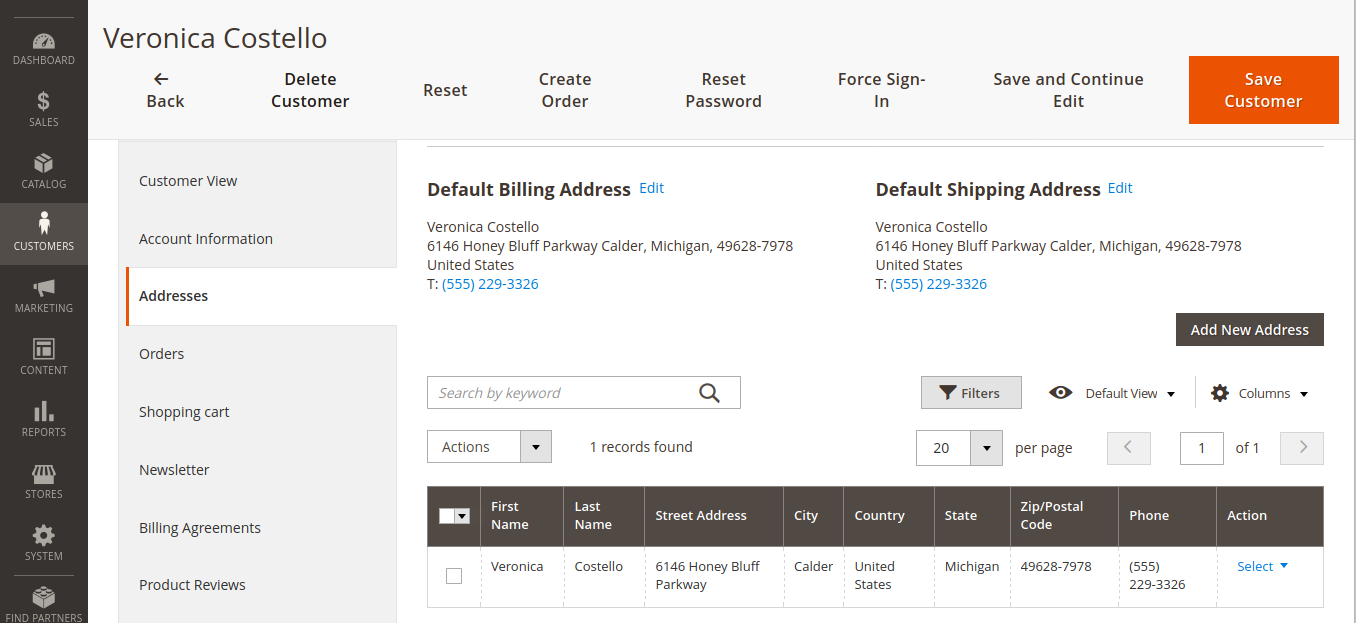
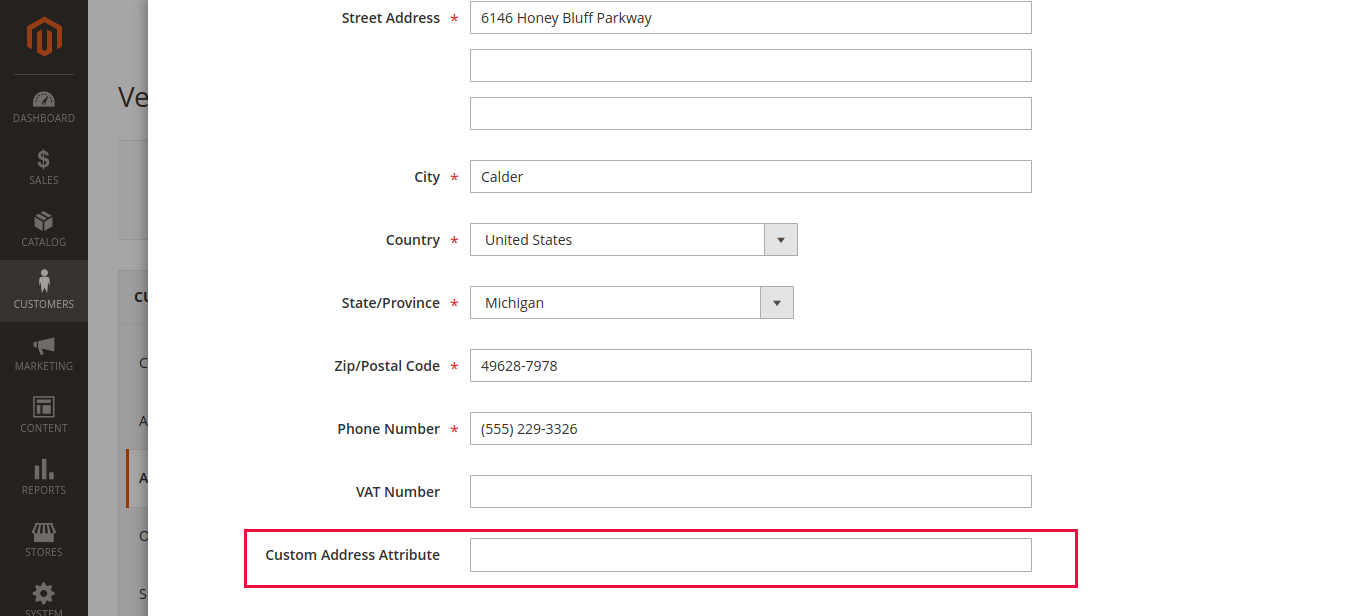
In the above code our attribute code is “custom_address_attribute” and the label is “Custom Address Attribute”.
Magento 2 Set Customer Custom Attribute Value
To set custom customer address attribute value we take Magento\Customer\Model\Address instance and created it’s object ($address) and used Magento\Customer\Model\ResourceModel\AddressFactory instance and created it’s object ($addressFactory).
To set custom customer value, firstly we create helper file at Mageants > Blog > Helper > Data.php
<?php

namespace Mageants\Blog\Helper;

class Data extends \Magento\Framework\App\Helper\AbstractHelper
{
    protected $address;
    protected $addressFactory;
    protected $storeManager;
    protected $addressRepositoryInterface;
    protected $pageFactory;

    public function __construct(
        \Magento\Customer\Model\Address $address,
        \Magento\Customer\Model\ResourceModel\AddressFactory $addressFactory,
        \Magento\Customer\Api\AddressRepositoryInterface $addressRepositoryInterface
    ) {
        $this->addressRepositoryInterface = $addressRepositoryInterface;
        $this->address = $address;
        $this->addressFactory = $addressFactory;
    }

    public function setCustomAttribute($customerId,$attributevalue)
    {
        $customerId = "1";
        $attributeCode = "custom_address_attribute";
        $customer = $this->address->load($customerId);
        $customerData = $customer->getDataModel();
        $customerData->setCustomAttribute($attributeCode,$attributevalue);
        $customer->updateData($customerData);
        $customerResource = $this->addressFactory->create();
        $customerResource->saveAttribute($customer,$attributeCode);
    }
}
|
Now, we create Controller file at Mageants > Blog > Controller > Index > Index.php
<?php

namespace Mageants\Blog\Controller\Index;

class Index extends \Magento\Framework\App\Action\Action
{
    protected $pageFactory;

    public function __construct(
        \Mageants\Blog\Helper\Data $helper,
        \Magento\Customer\Model\ResourceModel\AddressFactory $addressFactory,
        \Magento\Framework\App\Action\Context $context,
        \Magento\Framework\View\Result\PageFactory $pageFactory
    ) {
        $this->helper = $helper;
        $this->pageFactory = $pageFactory;

        return parent::__construct($context);
    }

    public function execute(){
        $customerId = "1"; $data = "Hello123";$this->helper->setCustomAttribute($customerId,$data);return $this->pageFactory->create();
    }
}
|
Magento 2 Get Customer Custom Attribute Value
To get custom customer address attribute value you have to use Magento\Customer\Api\AddressRepositoryInterface instance and created it’s object ($addressRepositoryInterface)
To get custom customer value, firstly we create Helper file at Mageants > Blog > Helper > Data.php
<?php

namespace Mageants\Blog\Helper;

class Data extends \Magento\Framework\App\Helper\AbstractHelper
{
    protected $address;
    protected $addressFactory;
    protected $storeManager;
    protected $addressRepositoryInterface;
    protected $pageFactory;

    public function __construct(
        \Magento\Customer\Model\Address $address,
        \Magento\Customer\Model\ResourceModel\AddressFactory $addressFactory,
        \Magento\Customer\Api\AddressRepositoryInterface $addressRepositoryInterface
    ) {
        $this->addressRepositoryInterface = $addressRepositoryInterface;
        $this->address = $address;$this->addressFactory = $addressFactory;
    }

    public function getCustomAttribute($customerId){
        $customerId = "1";
        $attributeCode = "custom_address_attribute";
        $customer = $this->addressRepositoryInterface->getById($customerId);
        print_r($customer->getCustomAttribute($attributeCode)->getValue());
    }
}
|
Now, we create controller file at Mageants > Blog > Controller > Index > Index.php
<?php

namespace Mageants\Blog\Controller\Index;

class Index extends \Magento\Framework\App\Action\Action
{
    protected $pageFactory;

    public function __construct(
        \Mageants\Blog\Helper\Data $helper,
        \Magento\Framework\App\Action\Context $context,
        \Magento\Framework\View\Result\PageFactory $pageFactory
    ) {
        $this->helper = $helper;
        $this->pageFactory = $pageFactory;

        return parent::__construct($context);
    }

    public function execute(){
        $customerId = "1";
        $this->helper->getCustomAttribute($customerId);
        return $this->pageFactory->create();
    }
}
|
Wrapping Up!
We hope this blog has helped you to clearly understand How to Create Customer Address Attribute in Magento 2 Programmatically.
In case of any kind of problem with the above code implementation, you can contact us.
